 What is the organism in question? Is there a zoonotic risk and what treatment options are available? This parasite is Linguatula serrata, an arthropod that lives in the nasal passages and naso-pharynx of carnivores. Infections can be subclinical but rhinitis and pharyngitis are common outcomes of infection so is the likely cause of the signs in this case.
Adult infection is obtained via the consumption of raw or undercooked viscera but humans may also act as intermediate hosts if eggs from mucoid discharge or faeces are accidentally ingested. This can lead to hepatic granulomas and rarely, aberrant migration to the lungs or anterior chamber of the eye. Therefore, good hand hygiene should be advised and facial licking by the dog should be avoided.
Treatment is primarily through surgical removal of the adult parasites. At least one case in the literature has been treated by weekly oral administration of milbemycin oxime leading to expulsion of the parasites. This would be a valid option to try first in this case but it would be important to stress that no product containing milbemycin oxime is licensed for this purpose and no large scale studies have been performed to assess its efficacy against this parasite.
Ivermectin is another option as this is not a Collie breed but there is only one case of treatment with this drug in the literature and that was to treat a closely related parasite, Linguatula artica in a reindeer. continue
What is the organism in question? Is there a zoonotic risk and what treatment options are available? This parasite is Linguatula serrata, an arthropod that lives in the nasal passages and naso-pharynx of carnivores. Infections can be subclinical but rhinitis and pharyngitis are common outcomes of infection so is the likely cause of the signs in this case.
Adult infection is obtained via the consumption of raw or undercooked viscera but humans may also act as intermediate hosts if eggs from mucoid discharge or faeces are accidentally ingested. This can lead to hepatic granulomas and rarely, aberrant migration to the lungs or anterior chamber of the eye. Therefore, good hand hygiene should be advised and facial licking by the dog should be avoided.
Treatment is primarily through surgical removal of the adult parasites. At least one case in the literature has been treated by weekly oral administration of milbemycin oxime leading to expulsion of the parasites. This would be a valid option to try first in this case but it would be important to stress that no product containing milbemycin oxime is licensed for this purpose and no large scale studies have been performed to assess its efficacy against this parasite.
Ivermectin is another option as this is not a Collie breed but there is only one case of treatment with this drug in the literature and that was to treat a closely related parasite, Linguatula artica in a reindeer. continue
Sunday, December 11, 2016
E-learning; clinical updates.
A 2 year old male springer spaniel presents with a history of episodic sneezing and mucoid bilateral nasal discharge since importation from Romania 2 weeks ago.
Chest auscultation is unremarkable but there is an increased gag reflex and resentment of nasal palpation. Rigid endoscopy reveals several segmented worm like organisms (below) ranging from 1 to 8cm long
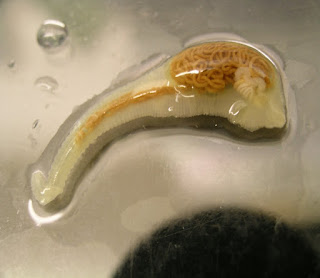 What is the organism in question? Is there a zoonotic risk and what treatment options are available? This parasite is Linguatula serrata, an arthropod that lives in the nasal passages and naso-pharynx of carnivores. Infections can be subclinical but rhinitis and pharyngitis are common outcomes of infection so is the likely cause of the signs in this case.
Adult infection is obtained via the consumption of raw or undercooked viscera but humans may also act as intermediate hosts if eggs from mucoid discharge or faeces are accidentally ingested. This can lead to hepatic granulomas and rarely, aberrant migration to the lungs or anterior chamber of the eye. Therefore, good hand hygiene should be advised and facial licking by the dog should be avoided.
Treatment is primarily through surgical removal of the adult parasites. At least one case in the literature has been treated by weekly oral administration of milbemycin oxime leading to expulsion of the parasites. This would be a valid option to try first in this case but it would be important to stress that no product containing milbemycin oxime is licensed for this purpose and no large scale studies have been performed to assess its efficacy against this parasite.
Ivermectin is another option as this is not a Collie breed but there is only one case of treatment with this drug in the literature and that was to treat a closely related parasite, Linguatula artica in a reindeer. continue
What is the organism in question? Is there a zoonotic risk and what treatment options are available? This parasite is Linguatula serrata, an arthropod that lives in the nasal passages and naso-pharynx of carnivores. Infections can be subclinical but rhinitis and pharyngitis are common outcomes of infection so is the likely cause of the signs in this case.
Adult infection is obtained via the consumption of raw or undercooked viscera but humans may also act as intermediate hosts if eggs from mucoid discharge or faeces are accidentally ingested. This can lead to hepatic granulomas and rarely, aberrant migration to the lungs or anterior chamber of the eye. Therefore, good hand hygiene should be advised and facial licking by the dog should be avoided.
Treatment is primarily through surgical removal of the adult parasites. At least one case in the literature has been treated by weekly oral administration of milbemycin oxime leading to expulsion of the parasites. This would be a valid option to try first in this case but it would be important to stress that no product containing milbemycin oxime is licensed for this purpose and no large scale studies have been performed to assess its efficacy against this parasite.
Ivermectin is another option as this is not a Collie breed but there is only one case of treatment with this drug in the literature and that was to treat a closely related parasite, Linguatula artica in a reindeer. continue
What is the organism in question? Is there a zoonotic risk and what treatment options are available? This parasite is Linguatula serrata, an arthropod that lives in the nasal passages and naso-pharynx of carnivores. Infections can be subclinical but rhinitis and pharyngitis are common outcomes of infection so is the likely cause of the signs in this case.
Adult infection is obtained via the consumption of raw or undercooked viscera but humans may also act as intermediate hosts if eggs from mucoid discharge or faeces are accidentally ingested. This can lead to hepatic granulomas and rarely, aberrant migration to the lungs or anterior chamber of the eye. Therefore, good hand hygiene should be advised and facial licking by the dog should be avoided.
Treatment is primarily through surgical removal of the adult parasites. At least one case in the literature has been treated by weekly oral administration of milbemycin oxime leading to expulsion of the parasites. This would be a valid option to try first in this case but it would be important to stress that no product containing milbemycin oxime is licensed for this purpose and no large scale studies have been performed to assess its efficacy against this parasite.
Ivermectin is another option as this is not a Collie breed but there is only one case of treatment with this drug in the literature and that was to treat a closely related parasite, Linguatula artica in a reindeer. continue

Subscribe to:
Post Comments (Atom)
Agribusiness Millionaires

Learn how to make money in agribusiness.
Popular Posts
-
Twitter https://veterinarymedicineechbeebolanle-ojuri.blogspot.com/2018/09/echbee-foods.html If you’re n...
-
 VETERINARY MEDICINE::10 MOST POPULAR WRINKLY DOGS THAT WILL BRING ADORABLE CUTENESS TO YOUR LIFE. The Chinese Shar Pei takes the first...
 -
Moringa a super-food additive is fast gaining recognition all over the world because of its outstanding properties that translate to our ...
-
Twitter https://veterinarymedicineechbeebolanle-ojuri.blogspot.com/ If you’re not redirected soon, please us...
-
 Food safety refers to methods,procedures and protocols that are practiced in food industry.These procedures/protocol are put in place durin...
 -
Locals eating radioactive food 30 years after Chernobyl: Greenpeace tests | NewsDaily
Claim your bonus here..

Free dog care guide.
CASSAVA BUSINESS

CASSAVA FLAKES.
No comments:
Post a Comment