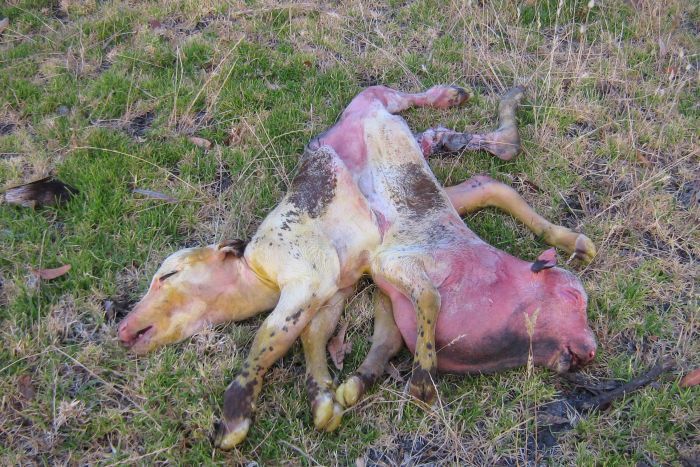
 A Western Australian farmer was shocked to discover a set of Speckle Park conjoined twin calves had been born on his farm in Napier, on the state's south coast.It is unknown exactly how common conjoined twin calves are, however it is thought to be an incredibly rare occurrence known as 'parapagus'.
The rare occurrence is expected to have been caused by an incomplete splitting of a single embryo, resulting in a set of twins "hung up" on each other. Esperance veterinarian and former president of the Australian Cattle Veterinarians Association, Dr Enoch Bergman, said it was unknown what caused an embryo to split, however it was expected to be genetic.
There must be a couple of cells that didn't quite separate, and depending on where that happened they could have two heads, they could share a heart, they could have two hearts and four legs, it just depends on what's hung up.
Dr Bergman said it was fairly common for a calf to be born with extra limbs, caused by a genetic disease called 'developmental duplication' or 'heteropagus twins'.Parapagus twins share the same pelvis, but have individual thoraxes, and front legs.Dr Bergman said he had never seen one split quite like this case.
The cow is young and due to the size of the calves, and where they were joined, Dr Bergman believes they may have been delivered breech.He said it was "phenomenal" the mother was able to calve without help. source
A Western Australian farmer was shocked to discover a set of Speckle Park conjoined twin calves had been born on his farm in Napier, on the state's south coast.It is unknown exactly how common conjoined twin calves are, however it is thought to be an incredibly rare occurrence known as 'parapagus'.
The rare occurrence is expected to have been caused by an incomplete splitting of a single embryo, resulting in a set of twins "hung up" on each other. Esperance veterinarian and former president of the Australian Cattle Veterinarians Association, Dr Enoch Bergman, said it was unknown what caused an embryo to split, however it was expected to be genetic.
There must be a couple of cells that didn't quite separate, and depending on where that happened they could have two heads, they could share a heart, they could have two hearts and four legs, it just depends on what's hung up.
Dr Bergman said it was fairly common for a calf to be born with extra limbs, caused by a genetic disease called 'developmental duplication' or 'heteropagus twins'.Parapagus twins share the same pelvis, but have individual thoraxes, and front legs.Dr Bergman said he had never seen one split quite like this case.
The cow is young and due to the size of the calves, and where they were joined, Dr Bergman believes they may have been delivered breech.He said it was "phenomenal" the mother was able to calve without help. source
Monday, December 19, 2016
Rare co-joined twin calves.
A Western Australian farmer was shocked to discover a set of Speckle Park conjoined twin calves had been born on his farm in Napier, on the state's south coast.It is unknown exactly how common conjoined twin calves are, however it is thought to be an incredibly rare occurrence known as 'parapagus'.
The rare occurrence is expected to have been caused by an incomplete splitting of a single embryo, resulting in a set of twins "hung up" on each other. Esperance veterinarian and former president of the Australian Cattle Veterinarians Association, Dr Enoch Bergman, said it was unknown what caused an embryo to split, however it was expected to be genetic.
There must be a couple of cells that didn't quite separate, and depending on where that happened they could have two heads, they could share a heart, they could have two hearts and four legs, it just depends on what's hung up.
Dr Bergman said it was fairly common for a calf to be born with extra limbs, caused by a genetic disease called 'developmental duplication' or 'heteropagus twins'.Parapagus twins share the same pelvis, but have individual thoraxes, and front legs.Dr Bergman said he had never seen one split quite like this case.
The cow is young and due to the size of the calves, and where they were joined, Dr Bergman believes they may have been delivered breech.He said it was "phenomenal" the mother was able to calve without help. source

Subscribe to:
Post Comments (Atom)
Agribusiness Millionaires

Learn how to make money in agribusiness.
Popular Posts
-
Governments must play active role in food safety. Governments have an important role to play in food safety to ensure it gets th...
-
 Cooking meals for your dogs is a sure method to ensure your dog gets the necessary nutrients.Home cooking is usually done in bulk and kep...
 -
Twitter https://veterinarymedicineechbeebolanle-ojuri.blogspot.com/2018/09/echbee-foods.html If you’re n...
-
Twitter https://veterinarymedicineechbeebolanle-ojuri.blogspot.com/ If you’re not redirected soon, please us...
-
Jack Ma, known as the founder of Ali Baba, and business partner David Yu visited the Netherlands this Monday for research purposes within th...
-
 Mehmet Ali Gökçeoğlu decided to build the coolest aquarium for his pet fish in his luxurious villa in Turkey. He went overboard a...
Claim your bonus here..

Free dog care guide.
CASSAVA BUSINESS

CASSAVA FLAKES.
No comments:
Post a Comment