Saturday, January 28, 2017
How to feed a cat.
The number of times you feed your cat and the way you present the meal could be one reason your pet is obese. According to a new research feeding your cat once or twice a day is contributing to the overweight issues common in most cats nowadays.
The researchers advice that actually feeding your cat small meals five times a day, including at night is a better nutrition protocol. These smaller meals mimics how your cat would eat if he were hunting and catching prey, such as mice. When cats are given a large amount of food in one sitting, they ignore their natural inclination to stop eating when they are full. Additionally, they are more sedentary, since they don’t need to hunt for their food, all of which can lead to obesity.
When you want to feed your cat, try to give him small portions of food at a time,or you can make feeding time resemble a hunt hiding bits of food throughout the house, or using a toy which requires your cat to play with it in order to dispense the food.
You can also play with your cat before feeding time to simulate how he would eat when hunting in the wild.If your cat is overweight, simply changing the way that you food him may help him to lose weight. You won’t notice an immediate change, but with a bit of time your cat’s weight should decrease. source

Reduce, replace and re-think the use of antimicrobials in animals.
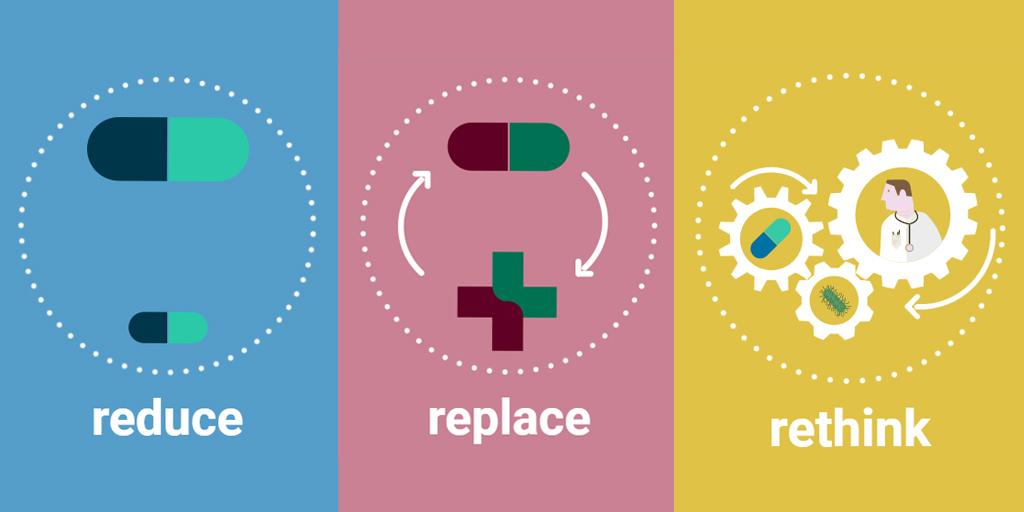
Reducing the use of antimicrobials in food-producing animals, replacing them where possible and re-thinking the livestock production system is essential for the future of animal and public health.
Antimicrobial resistance (AMR) is one of the world’s most pressing public health issues and the use of antimicrobials in animals contributes to this problem, so limiting their use to the minimum necessary to treat infectious diseases in animals is crucial.
Control strategies that have been important drivers for change include setting of national targets to reduce antimicrobial use.
The use of antimicrobials in animals should be reduced to the minimum that is necessary to treat infectious diseases. Other than in exceptional cases, their use to prevent such diseases should be phased out in favour of alternative measures.
Critically important antimicrobials for human medicine should only be used in animals as a last resort. Alternatives to antimicrobials that have been shown to improve animal health and thereby reduce the need to use antimicrobials include vaccines, probiotics, prebiotics, bacteriophages and organic acids.
However, reducing the use of antimicrobials and finding alternatives is not enough. There is a need to re-think the livestock system by implementing farming practices that prevent the introduction and spread of the disease into farms and by considering alternative farming systems which are viable with reduced use of antimicrobials.
Education and awareness of AMR should be addressed to all levels of society but in particular to veterinarians and farmers.
Experts concluded that it is reasonable to assume that reducing antimicrobial use in food-producing animals would result in a general decrease in antimicrobial resistance in the bacteria that they carry and the food products derived from them.
However, they could not quantify the impact of single reduction measures or alternatives to antimicrobials on levels of antimicrobial resistance in food-producing animals and food due to lack of data. continue
Blood bank for cats.
A blood bank for cats is run in Australia ,giving hope to cats who need blood transfusions to recover from trauma and anemia and to survive major surgery or cancer.The Animal Hospital at Murdoch University treats and saves many critically ill cats at its emergency clinic, the demand for blood has continued to rise and the hospital is calling on donors to keep the blood bank functioning.
Donor cats get a free vet examination with every donation and the pool of donors is made up with felines owned by veterinary staff and students. In the past and in a lot of smaller clinics, if a vet had a patient that needed a blood transfusion, they would often pop home and get their dog or cat, bring it in and collect a blood donation. The blood bank has changed all that,where blood is pooled from donors and used when needed.
Harry almost died from blood poisoning but was saved by transfusion from the community blood bank ,now Harry donates blood to the center to help other cats. The recovery is fine and the cat doesn’t suffer in any way. The procedure for donation is simple, it involves dropping your cat off at the clinic in the morning and pickup your cat at the end of the day. Cats who give blood are given anesthesia during the procedure. source
Friday, January 27, 2017
Dog donates blood to save life of cat that had eaten rat poison.
Rodenticide poisoning in pets accounts for a large percentage of deaths in households basically because pets are curious ravaging and rooting at every corner and most importantly the owners were not discrete when applying baits.
Rodenticide poisoning is an emergency and its easy to prevent your pets from consuming the poison than running around after deed is done. Read how to lay baits in the house to prevent poisoning in pets. see
When the level of poisoning is high and condition critical,peculiar interventions can be employed to save the pet. This was what happened when a cat ate rat poison,the owner rushed to the vet who did what she could do to save the cat.
The vet did a blood transfusion using a dog's blood and luck was on her side as she did not have time to type the blood,but cat survived. The owner is happy and cat is doing well and without any doggy behavior. read
Bulgarian stray cats get bionic legs .
Bulgarian stray cats get bionic legs.Two stray Bulgarian cats who lost their hind legs in accidents have been given bionic paws, in what vets say is the first such operation in Europe outside Britain. One-year-old Pooh, whose name means "fluff" in Bulgarian, scurries around Sofia's Central Vet Clinic, chasing a toy mouse and curiously sniffing at medicine bottles inside an open cupboard—just like any other cat would.
The only difference is a gentle tapping sound as his two tiny polymer-and-rubber paws mounted on titanium stems touch the floor.
Pooh, who is thought to have lost his legs in a car or train accident last April, is back on the prowl thanks to Bulgarian veterinary surgeon Vladislav Zlatinov.
He is the first vet in Europe to successfully apply the pioneering method of Irish neuro-orthopaedic surgeon Noel Fitzpatrick, who shot to fame in 2009 when making Oscar the first bionic cat by fitting him with new hind legs in Britain. continue
Corn turning French hamsters into deranged cannibals.
A new research has shown that corn turning French hamsters into deranged cannibals.A diet of corn is turning wild hamsters in northeastern France into deranged cannibals that devour their offspring, there is an imbalance, and the hamster habitat is collapsing.
The findings, reported in the journal Proceedings of the Royal Society of London B, finger industrial-scale monoculture as the culprit. Once nourished by a variety of grains, roots and insects, the burrowing rodents live today in a semi-sterile and unbroken ocean of industrially grown maize, or corn. The monotonous diet is leaving the animals starving, the problem is a lack of vitamins especially vitamin B3, or niacin.
According to the report, A first set of lab experiments with wild specimens compared wheat and corn-based diets, with side dishes of clover or worms. There was virtually no difference in the number of pups born, or the basic nutritional value of the different menus.,but when it came to survival rates, the difference was dramatic.
About four-fifths of the pups born of mothers feasting on wheat-and-clover or wheat-and-worms were weaned. while only 5% , of the baby hamsters whose mothers ate corn instead of wheat stayed alive that long. These females stored their pups with their hoards of maize before eating them, and Pups were still alive at that time. The cannibal mothers showed other signs of abnormality,such as climbing,running in circles and pounding their feeders.
The females also had swollen and dark tongues, and blood so thick it was difficult to draw for samples. Vitamin B3 deficiency has been linked to 'black-tongue' syndrome in dogs, and a condition in humans called pellagra, also known as the "3-D" disease: diarrhoea, dementia and dermatitis, such as eczema.
Feedback and disease prevention in pigs.
Feedback and disease prevention in pigs. The term feedback refers to methods of controlled antigen oral exposure in pig farming,and several methods have been explored to stimulate antibodies in the sows and piglet. The major benefit of feedback is to ensure a disease free stock and production of healthy piglets. The feedback material is usually fed to the sows 8-10 weeks before farrowing to ensure that colostrum is concentrated with antibodies.
The common form of feedback material is fecal matter from scouring pigs or from sows in gestation and this will generate maternal antibodies that will be available through colostrum. Pig intestines from sick pigs,low-weight piglets and from dying neonates. The purpose is to extract a concentrated material that contains specific bacterial agents that came from sow feces and the best source for these agents is probably the intestines of young pigs.
Another feedback method involves freezing the material into ice blocks giving the pigs access to lick and chew before it melts or the feedback is processed and the slurry is poured on the sows feed.
The efficacy of feedback depends on the time of giving feedback, type of feedback collected and the housing arrangement of the sows.The housing arrangement is key as feedback practice has proved to become more difficult when keeping gestating sows in groups, as sows are free to move around and When using electronic Sow Feeding (ESF) stations as the sows are not simultaneously fed,thus exposure to feedback is not uniform.
A research published in the Journal of Swine Health and Production says providing additional ice blocks to sows might overcome the nonuniform exposure to feedback and thus confer herd immunity.Enteric pathogens of swine can be frozen and still be viable. Ice blocks could provide a convenient and effective vehicle for controlled exposure of pathogens to pen-gestating sows if sufficient numbers of sows interact with the ice blocks before they melt.
The research shows, that when ice was placed in the pen on two consecutive time points 1 week apart, over 90% of the sows in the large dynamic pen contacted the ice. When 4 blocks were used instead of 2 blocks,this increased the number of sows to make contact with the ice, as well as increasing the duration of contact by individual sows and decreasing aggression at the ice block.
Subscribe to:
Comments (Atom)
Agribusiness Millionaires

Learn how to make money in agribusiness.
Popular Posts
-
 Its the weekend and a great time for a makeover for your pets; wash,shampoo and groom them. Check out these funny grooming options ; pho...
 -
Vitamin D may boost IBD treatment success: Study : Low vitamin D levels may reduce the chances of success of treatment for inflammatory bowe...
-
Honesty, transparency and understanding – those were the key words used when describing the outcome of the first Tri-State Sow Housing Confe...
-
 STOP THE BIRD FLU VIRUS! 1) Avoid contact with dead poultry, wild birds and strange birds of unknown origin. 2)Avoid contact with...
 -
Vaccination linked to brain damage in canines. Neurological damage is one of the most prevalent and least desired adverse effects of the v...
-
GASPARD Kabalisa is a management consultant, who has exploited his entrepreneurship and managerial experience and skills to rake in millio...
Claim your bonus here..

Free dog care guide.
CASSAVA BUSINESS

CASSAVA FLAKES.