 The report shows that the diagnostic team found microscopic lesions in the pigs’ central nervous tissues containing a novel sapelovirus that researchers hadn’t previously encountered. Sapeloviruses belong to a family of viruses commonly found in pigs, but this particular strain was different from all other sapeloviruses previously described.
Reporting findings suggests, a lack of scientific evidence regarding the virus means it’s impossible to know just how widely it may spread, but the epidemiology of other viruses within its family leads the team to believe this particular strain may be fairly common on US hog farms. However, only a small percentage of pigs with the virus likely will display symptoms, and there is no evidence now that suggests pork is unsafe to eat.more
The report shows that the diagnostic team found microscopic lesions in the pigs’ central nervous tissues containing a novel sapelovirus that researchers hadn’t previously encountered. Sapeloviruses belong to a family of viruses commonly found in pigs, but this particular strain was different from all other sapeloviruses previously described.
Reporting findings suggests, a lack of scientific evidence regarding the virus means it’s impossible to know just how widely it may spread, but the epidemiology of other viruses within its family leads the team to believe this particular strain may be fairly common on US hog farms. However, only a small percentage of pigs with the virus likely will display symptoms, and there is no evidence now that suggests pork is unsafe to eat.more
Thursday, October 20, 2016
New virus associated with polio-like symptoms in pigs.
A new virus associated with polio-like symptoms in pigs has been discovered by US researchers . This is a novel virus in the central nervous tissues of young pigs with polio-like weakness in their hind legs.Farms dealing with the disease may lose 1-2% of pigs, making it a concern for individual producers
The Iowa State University reported that Paulo Arruda, an assistant professor of veterinary diagnostic and production animal medicine, led a team of diagnosticians from Iowa State, the University of Minnesota and Kansas State University. They investigated samples from 11-week-old pigs that couldn’t walk due to a mysterious weakness in their hind legs.
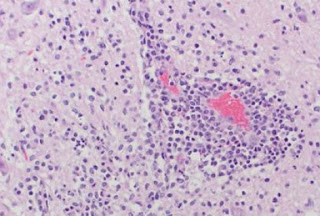 The report shows that the diagnostic team found microscopic lesions in the pigs’ central nervous tissues containing a novel sapelovirus that researchers hadn’t previously encountered. Sapeloviruses belong to a family of viruses commonly found in pigs, but this particular strain was different from all other sapeloviruses previously described.
Reporting findings suggests, a lack of scientific evidence regarding the virus means it’s impossible to know just how widely it may spread, but the epidemiology of other viruses within its family leads the team to believe this particular strain may be fairly common on US hog farms. However, only a small percentage of pigs with the virus likely will display symptoms, and there is no evidence now that suggests pork is unsafe to eat.more
The report shows that the diagnostic team found microscopic lesions in the pigs’ central nervous tissues containing a novel sapelovirus that researchers hadn’t previously encountered. Sapeloviruses belong to a family of viruses commonly found in pigs, but this particular strain was different from all other sapeloviruses previously described.
Reporting findings suggests, a lack of scientific evidence regarding the virus means it’s impossible to know just how widely it may spread, but the epidemiology of other viruses within its family leads the team to believe this particular strain may be fairly common on US hog farms. However, only a small percentage of pigs with the virus likely will display symptoms, and there is no evidence now that suggests pork is unsafe to eat.more
The report shows that the diagnostic team found microscopic lesions in the pigs’ central nervous tissues containing a novel sapelovirus that researchers hadn’t previously encountered. Sapeloviruses belong to a family of viruses commonly found in pigs, but this particular strain was different from all other sapeloviruses previously described.
Reporting findings suggests, a lack of scientific evidence regarding the virus means it’s impossible to know just how widely it may spread, but the epidemiology of other viruses within its family leads the team to believe this particular strain may be fairly common on US hog farms. However, only a small percentage of pigs with the virus likely will display symptoms, and there is no evidence now that suggests pork is unsafe to eat.more

New blood test against Nagana disease.
A study recently published in the journal PLOS Neglected Tropical Diseases, shows that the cattle disease nagana, also called African animal trypanosomosis can be detected using a simple but effective device.
The device, less than 3 inches long and similar in format to a pregnancy test, can identify within 30 minutes whether or not an animal is infected with the parasite Trypanosoma vivax from a single drop of blood.
The University of Dundee and the Global Alliance for Livestock Veterinary Medicines (GALVmed) partnered to develop this simple and effective device that tests for Nagana disease that is endemic in 40 African countries and accounts for up to a 50% loss in milk and meat production in the continent. The simple device does not require electricity or any additional equipment, which makes it a tool of importance in developing countries,where resources are limited.
 The cattle disease,African animal trypanosomosis, is caused mainly by 2 parasite species: 1) Trypanosoma vivax 2) Trypanosoma congolense .It affects wide spread areas of sub-Saharan Africa. The T. vivax form of nagana has also spread to South America. There are about 60 million cattle at risk from the disease, that causes muscle wasting and death.
The socio-economic impacts of nagana are profound,as it impacts on the lives of millions of smallholder farmers and the economy.The prototype diagnostic device was evaluated with over 100 serum samples from uninfected and T. vivax-infected cattle. more
The cattle disease,African animal trypanosomosis, is caused mainly by 2 parasite species: 1) Trypanosoma vivax 2) Trypanosoma congolense .It affects wide spread areas of sub-Saharan Africa. The T. vivax form of nagana has also spread to South America. There are about 60 million cattle at risk from the disease, that causes muscle wasting and death.
The socio-economic impacts of nagana are profound,as it impacts on the lives of millions of smallholder farmers and the economy.The prototype diagnostic device was evaluated with over 100 serum samples from uninfected and T. vivax-infected cattle. more
 The cattle disease,African animal trypanosomosis, is caused mainly by 2 parasite species: 1) Trypanosoma vivax 2) Trypanosoma congolense .It affects wide spread areas of sub-Saharan Africa. The T. vivax form of nagana has also spread to South America. There are about 60 million cattle at risk from the disease, that causes muscle wasting and death.
The socio-economic impacts of nagana are profound,as it impacts on the lives of millions of smallholder farmers and the economy.The prototype diagnostic device was evaluated with over 100 serum samples from uninfected and T. vivax-infected cattle. more
The cattle disease,African animal trypanosomosis, is caused mainly by 2 parasite species: 1) Trypanosoma vivax 2) Trypanosoma congolense .It affects wide spread areas of sub-Saharan Africa. The T. vivax form of nagana has also spread to South America. There are about 60 million cattle at risk from the disease, that causes muscle wasting and death.
The socio-economic impacts of nagana are profound,as it impacts on the lives of millions of smallholder farmers and the economy.The prototype diagnostic device was evaluated with over 100 serum samples from uninfected and T. vivax-infected cattle. more
The use of probiotic yeast in ruminant feed to reduce methane emission.
The climate change has propelled every one towards the journey to seek out better practices to save our world.Agriculture has been slammed as one of the major contributors to these changes,hence the call to practice smart agriculture.
The world food day 2016 slogan says it all" climate is changing,food and agriculture must too".The race is on,to reduce the effect of agricultural practices on the climate while on the other hand produce enough food to feed the growing population without disrupting the ecosystems.
The majority of emissions from livestock has been pinned on ruminants because of their flatulence and ruminal fermentation,that releases a lot of greenhouse gases into the atmosphere. The approach to reduce emissions through smart agriculture is taking different approaches such as enclosed cubicles for cattle to trap gases, feed management practices and addition of feed additives such as proboitic yeast.
One of the challenges of a growing livestock sector is the contribution of livestock to the global greenhouse gas emission. Ruminants contribute to climate change by emitting greenhouse gases which are carbon dioxide, methane and nitrous oxide directly from enteric fermentation or indirectly from feed production activities and deforestation to create new pasture .
These gas emission by these ruminants can be reduced by using feed additives such as probiotic yeast . The gas emission has a negative effect on the animals as well, it results in 2–12% of energy intake loss for the animal. Therefore, there is a need to develop efficient feeding strategies to reduce methane production, which will beneficially affect the environment and will also improve nutrient digestion in the animal.
In ruminants, probiotic yeast are used to manipulate the ruminal microbial population and thus ruminal fermentation to maximize the efficiency of feed utilization to further increase the productivity, in terms of milk, meat, and wool production. When feed utilization is increased, methane production can be reduced also, so to reduce methane emissions the key will be to increase feed utilization.
The Food and Agricultural Organisation (FAO) has published an extensive report on the production, impact and regulation of probiotics for animal nutrition, where they opined they can work, but their efficacy is highly variable.The ability of an organism to be an effective probiotic has also been found to be strain–specific and dosage dependent.
Wednesday, October 19, 2016
How foster farms resolved food safety crisis.
Robert O’Connor, DVM, head veterinarian of Foster Farms provided first-hand lessons from his experience in August 2013, when Foster Farms received a call from the USDA and Centers for Disease Control (CDC) that there had been 125 cases of multidrug resistant Salmonella illness in 15 states that seemed to be linked to the company’s products.
“First thing is, you get hit – broadsided. Torpedo hits the side of the ship. You have to take action.” While the company was often working with incomplete information, O’Connor reported that a number of actions were taken that sharply reduced Salmonella throughout the company’s growing and processing facilities.
1) Tightening up on production site bio security.
2) Insistence on deliveries only of Salmonella-negative replacement birds.
3) Installation of plastic sheeting in the house so pullets could not access old litter.
4) changing the Salmonella vaccine to one that protected specifically against Heidelberg.
5) vaccinating broilers (in addition to pullets and layers).6) Adding probiotics to the feed.
7) Installing an additional washing step for parts in the processing plant.
8) The complete depopulation and subsequent cleaning and disinfection of some poultry houses. more
Foster Farms’ vet shares tips for managing a food-safety crisis in the poultry industry.
Robert O’Connor, DVM, head veterinarian of Foster Farms, in a presentation at the 2016 American Association of Avian Pathologists conference talks about what to do when facing a food safety crisis
O’Connor provided first-hand lessons from his experience in August 2013, when Foster Farms received a call from the USDA and Centers for Disease Control (CDC) that there had been 125 cases of multidrug resistant Salmonella illness in 15 states that seemed to be linked to the company’s products.
He offered these tips to his fellow poultry veterinarians: 1) Forget the crisis-management plan. While it’s important for every company to have one, he cautioned not to rely on it too heavily. “The crisis management plan is a big abstract. However, it won’t fully address the situational, everyday kind of variables that get thrown at you during a crisis.
”The most important chapter, he added, was the plan’s contact list for key people in the company. It will be of little value, however — and also a source of great frustration — if the names, titles and contact information aren’t current. “That’s what is most important in your crisis-management plan — the contact list,” he emphasized, urging veterinarians to make sure it’s updated frequently.
2) Take the lead. On qualifying, veterinarians take an oath to use their skills and knowledge to benefit society, and that includes public health. In the cases of a zoonotic crisis such as Salmonella, technical input is essential to identify and implement solutions. The veterinarian, he added, likely has the strongest scientific education and applied experience to fully understand the technical landscape and should guide members of the executive team accordingly.
3) Gather key players. Reach out to your network and ask for help, O’Connor recommended. People with a whole range of skills and expertise are needed including a communications officer to handle the media and other external messaging 24/7, and a spokesperson to be the face of the company. Also essential is a scribe to record, for future reference, every discussion within the team and all incoming and outgoing information concerning the case.
4) Set up a crisis center – a “war room.” A room needs to be set aside for the sole use of the crisis team. It might be the company’s boardroom, and it must be fully equipped with multiple internet, telephone and teleconference connections.
5) Be prepared to take action — quickly. As scientists, he noted, veterinarians usually don’t like to take action without some data to support their actions. “But I am here to tell you, in a crisis, you sometimes do take action without the full data to support you. They don’t want you taking action tomorrow; they wanted it yesterday,” O’Connor said.
6) Measure and collect data. The crisis team’s deep understanding of the company’s business will identify possible sources of the problem. Critical thinking will lead to the most likely issues. O’Connor recommended collecting as much data as possible to support the action taken and/or to refine it to bring about a complete solution.
7) Learn lessons so the crisis will never be repeated. For Foster Farms, this Salmonella incident was officially closed in July of 2014, a full year after that first call from the USDA and CDC. But O’Connor continues to speak about it, and he explained why. “To me and for the company, it was almost doomsday,” he said. “The guarantees we make to our consumers and customers for quality and safety are our highest priority. So why keep talking about the crisis? Because I want to prevent it from ever happening again.”
culled from poultry health today.
One dairy farmer gives rousing milking speech to his herd.
This Australian dairy farmer is taking no prisoners as he gears up for the spring milking season, giving a rousing sports-like pep talk to his cows before they go to the parlor.
“We’ve done a lot of hard work over the last few months, setting up the season, spring is where it counts,” Adam Jenkins, the dairy farmer, says in the video. Calling out the cow 291 Jersey, he told her she has to milk really well tonight, no excuses, and that she has to be committed.Watch
FAO launches an umbrella programme to support responsible investments in agriculture and food systems.
Increasing investments in agriculture is crucial to end hunger and poverty by 2030. Achieving the first two Sustainable Development Goals will require allocating a substantial amount above and beyond the current level of investment in agriculture and rural development.
At the same time, not all kinds of investments are equally beneficial. In order to generate sustainable benefits for all, it is essential that investments are responsible – addressing the needs of communities, farmers, investors and the broader environment.
However, current limitations in awareness, governance, capacities and information can obstruct responsible investment. This leads to investments that may cause hardship for rural communities, including the loss of lands and livelihoods, and are unlikely to generate benefits for investors.
The role of information is vital to proper investment in agriculture to ensure the goal of food security is ensured, see this
Enhancing responsible agricultural investment requires supporting and engaging all relevant actors. With more than 50 years of experience and recognized expertise in all types of investment, as well as related socio-economic and human rights challenges, FAO is well placed to achieve this. continue
Subscribe to:
Comments (Atom)
Agribusiness Millionaires

Learn how to make money in agribusiness.
Popular Posts
-
Five ways agriculture could benefit from artificial intelligence. Agriculture is the industry that accompanied the evolution of humanity ...
-
WHO warned that a large epidemic of yellow fever is possible in Brazil after dozens of suspected deaths from the disease were reported in ...
-
A high School graduate Tyler Thompson wanted to give his cats a taste of the good life, so he developed Koop Brand. Though several oth...
-
 Researchers have muted an idea that a part of the digestive system should be upgraded to an organ status. The mesentery according to a new...
 -
 Poultry is a well established agribusiness,with investments in the various value chain. The waste component of the business has been a...
 -
Vitamin D may boost IBD treatment success: Study : Low vitamin D levels may reduce the chances of success of treatment for inflammatory bowe...
Claim your bonus here..

Free dog care guide.
CASSAVA BUSINESS

CASSAVA FLAKES.