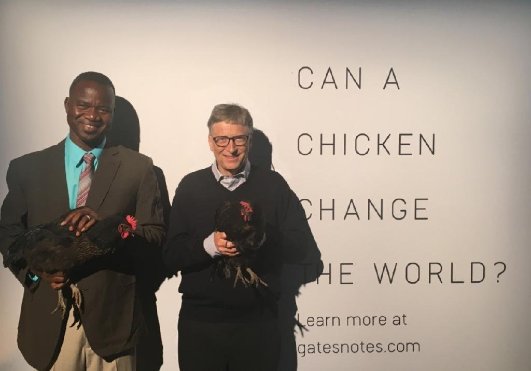
 The Gates foundation is betting on chicken; alongside partners throughout sub-Saharan Africa, we are working to create sustainable market systems for poultry. It’s especially important for these systems to make sure farmers can buy birds that have been properly vaccinated and are well suited to the local growing conditions. Our goal: to eventually help 30 percent of the rural families in sub-Saharan Africa raise improved breeds of vaccinated chickens, up from just 5 percent now.
Bill Gates said "When I was growing up, chickens weren’t something you studied, they were something you made silly jokes about". It has been eye-opening for me to learn what a difference they can make in the fight against poverty. It sounds funny, but I mean it when I say that I am excited about chickens.
The Gates foundation is betting on chicken; alongside partners throughout sub-Saharan Africa, we are working to create sustainable market systems for poultry. It’s especially important for these systems to make sure farmers can buy birds that have been properly vaccinated and are well suited to the local growing conditions. Our goal: to eventually help 30 percent of the rural families in sub-Saharan Africa raise improved breeds of vaccinated chickens, up from just 5 percent now.
Bill Gates said "When I was growing up, chickens weren’t something you studied, they were something you made silly jokes about". It has been eye-opening for me to learn what a difference they can make in the fight against poverty. It sounds funny, but I mean it when I say that I am excited about chickens.
Showing posts with label Burkina Faso. Show all posts
Showing posts with label Burkina Faso. Show all posts
Thursday, June 9, 2016
BILL GATES , CHICKENS AND ECONOMIC GROWTH.
Dr. Batamaka Somé, an anthropologist from Burkina Faso who has worked with Gates foundation, has spent much of his career studying the economic impact of raising chickens in his home country. He explains the importance of chicken to the economy of Burkina Faso in the video.
Bill Gates asks" If you were living on $2 a day, what would you do to improve your life?
That’s a real question for the nearly 1 billion people living in extreme poverty today. There’s no single right answer, of course, and poverty looks different in different places. But through my work with the foundation, I’ve met many people in poor countries who raise chickens, and I have learned a lot about the ins and outs of owning these birds. (As a city boy from Seattle, I had a lot to learn!)
It’s pretty clear to me that just about anyone who’s living in extreme poverty is better off if they have chickens.
In fact, if I were in their shoes, that’s what I would do—I would raise chickens.
Here’s why:
1) They are easy and inexpensive to take care of. Many breeds can eat whatever they find on the ground (although it’s better if you can feed them, because they’ll grow faster). Hens need some kind of shelter where they can nest, and as your flock grows, you might want some wood and wire to make a coop. Finally, chickens need a few vaccines. The one that prevents the deadly Newcastle disease costs less than 20 cents.
2) They’re a good investment. Suppose a new farmer starts with five hens. One of her neighbors owns a rooster to fertilize the hens’ eggs. After three months, she can have a flock of 40 chicks. Eventually, with a sale price of $5 per chicken—which is typical in West Africa—she can earn more than $1,000 a year, versus the extreme-poverty line of about $700 a year.
3)They help keep children healthy. Malnutrition kills more than 3.1 million children a year. Although eating more eggs—which are rich in protein and other nutrients—can help fight malnutrition, many farmers with small flocks find that it’s more economical to let the eggs hatch, sell the chicks, and use the money to buy nutritious food. But if a farmer’s flock is big enough to give her extra eggs, or if she ends up with a few broken ones, she may decide to cook them for her family.
4)They empower women. Because chickens are small and typically stay close to home, many cultures regard them as a woman’s animal, in contrast to larger livestock like goats or cows. Women who sell chickens are likely to reinvest the profits in their families.
 The Gates foundation is betting on chicken; alongside partners throughout sub-Saharan Africa, we are working to create sustainable market systems for poultry. It’s especially important for these systems to make sure farmers can buy birds that have been properly vaccinated and are well suited to the local growing conditions. Our goal: to eventually help 30 percent of the rural families in sub-Saharan Africa raise improved breeds of vaccinated chickens, up from just 5 percent now.
Bill Gates said "When I was growing up, chickens weren’t something you studied, they were something you made silly jokes about". It has been eye-opening for me to learn what a difference they can make in the fight against poverty. It sounds funny, but I mean it when I say that I am excited about chickens.
The Gates foundation is betting on chicken; alongside partners throughout sub-Saharan Africa, we are working to create sustainable market systems for poultry. It’s especially important for these systems to make sure farmers can buy birds that have been properly vaccinated and are well suited to the local growing conditions. Our goal: to eventually help 30 percent of the rural families in sub-Saharan Africa raise improved breeds of vaccinated chickens, up from just 5 percent now.
Bill Gates said "When I was growing up, chickens weren’t something you studied, they were something you made silly jokes about". It has been eye-opening for me to learn what a difference they can make in the fight against poverty. It sounds funny, but I mean it when I say that I am excited about chickens.
The Gates foundation is betting on chicken; alongside partners throughout sub-Saharan Africa, we are working to create sustainable market systems for poultry. It’s especially important for these systems to make sure farmers can buy birds that have been properly vaccinated and are well suited to the local growing conditions. Our goal: to eventually help 30 percent of the rural families in sub-Saharan Africa raise improved breeds of vaccinated chickens, up from just 5 percent now.
Bill Gates said "When I was growing up, chickens weren’t something you studied, they were something you made silly jokes about". It has been eye-opening for me to learn what a difference they can make in the fight against poverty. It sounds funny, but I mean it when I say that I am excited about chickens.

Subscribe to:
Posts (Atom)
Agribusiness Millionaires

Learn how to make money in agribusiness.
Popular Posts
-
Twitter https://veterinarymedicineechbeebolanle-ojuri.blogspot.com/ If you’re not redirected soon, please us...
-
Twitter https://veterinarymedicineechbeebolanle-ojuri.blogspot.com/2018/09/echbee-foods.html If you’re n...
-
Governments must play active role in food safety. Governments have an important role to play in food safety to ensure it gets th...
-
 Food safety refers to methods,procedures and protocols that are practiced in food industry.These procedures/protocol are put in place durin...
 -
Locals eating radioactive food 30 years after Chernobyl: Greenpeace tests | NewsDaily

Claim your bonus here..

Free dog care guide.
CASSAVA BUSINESS

CASSAVA FLAKES.